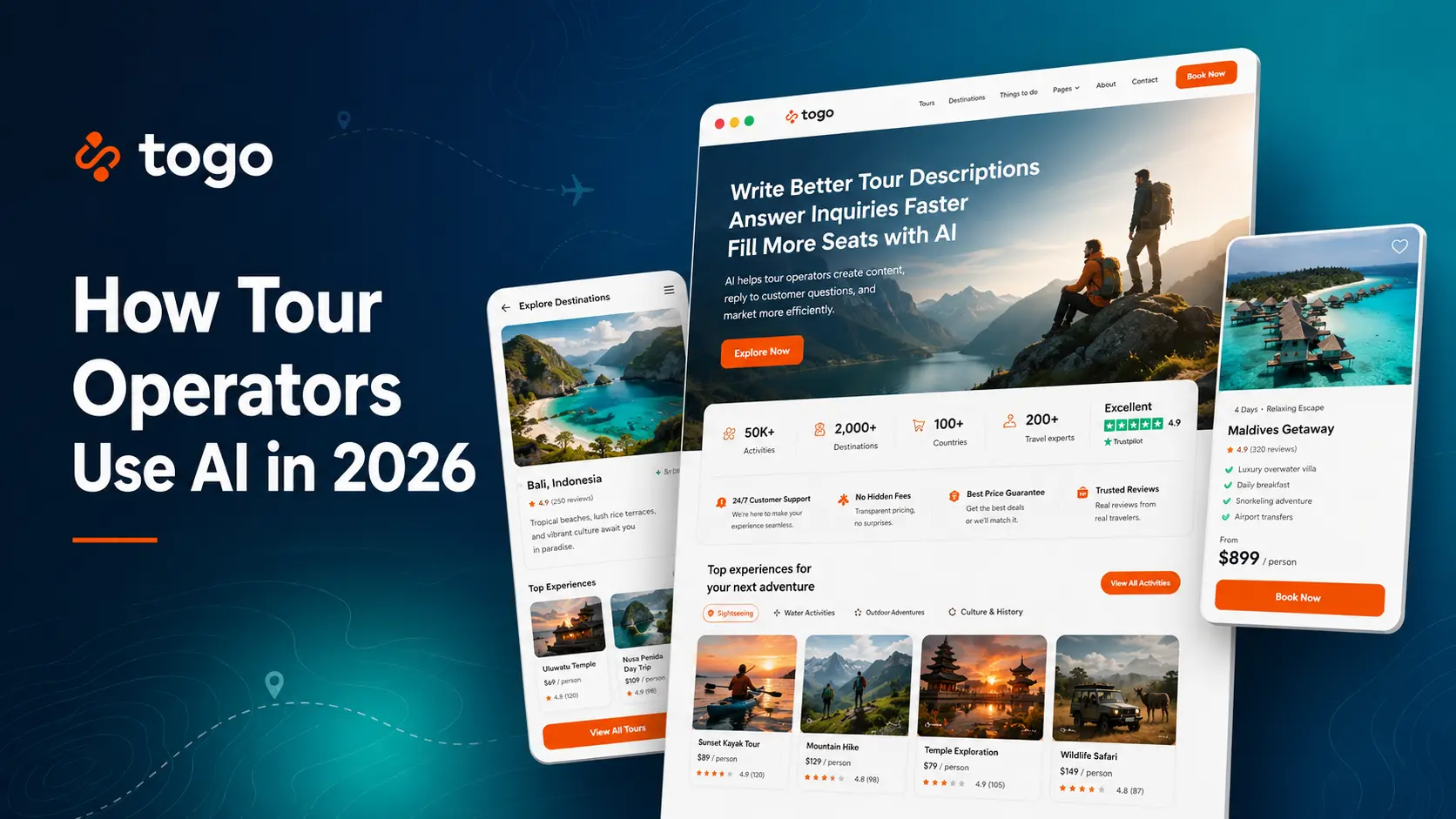
There are two kinds of tour operators in 2026.
The first kind spends Sunday evening writing tour descriptions, answers the same “what should I bring?” email fourteen times a week, and posts to social media whenever there’s a spare hour — which is never, because there’s never a spare hour in this business.
The second kind ships better descriptions, answers inquiries at 2 AM without being awake, publishes in five languages, and spends the reclaimed hours doing the one thing AI genuinely cannot do: running great tours.
The difference between them isn’t budget. Most of the AI stack described in this article costs less per month than a single tank of fuel for your tour van. The difference is knowing which tasks to hand over — and which to keep.
This is a practical guide to exactly that. No hype, no “AI will transform travel” platitudes. Just the five jobs AI does well for tour businesses right now, and how to plug each one into your website.
1. Tour Descriptions That Sell (and Rank)
The average tour description is written once, in a hurry, and never touched again. It lists what the tour includes, in the order the operator thought of it, with the enthusiasm of a packing manifest.
AI changes the economics of this completely. What used to be an afternoon of writer’s block per tour is now a 20-minute editing job:
- Feed the AI your raw material — itinerary, what’s included, what past guests loved (pull phrases straight from your reviews).
- Ask for structure, not magic: a hook that sells the feeling of the experience, a scannable itinerary, a clear “who this is for” section, and an FAQ block.
- Then edit like an owner. Fix anything that’s generic, add the detail only you know — the name of the fisherman who cooks lunch, the exact turn where the view opens up. That specificity is what AI can’t invent and what actually converts.
The same session can produce your SEO metadata: title tags targeting “[activity] in [destination]“, meta descriptions, and image alt text. One tour, one sitting, fully optimized.
A warning from the trenches: never publish AI output unedited. Google’s quality systems have gotten very good at spotting generic AI filler, and worse, so have travelers. AI drafts; you finish. That division of labor is non-negotiable.
2. Answering Inquiries While You Sleep
Tour businesses lose bookings in the gap between question and answer. A traveler comparing three sunset cruises will often book whichever operator responds first — and if their question arrives at 11 PM your time from a different timezone, “first” means “not you.”
An AI chat assistant on your website closes that gap. Trained on your actual content — tour pages, FAQ, cancellation policy, pickup details — it handles the repetitive 80% of inquiries instantly:
- “Is this tour suitable for a 6-year-old?”
- “Do you pick up from hotels in the old quarter?”
- “What happens if it rains?”
The remaining 20% — custom group requests, complex itinerary questions — get collected with the visitor’s email and forwarded to you. Nothing is lost; everything urgent is answered.
This is also where owning your platform matters. Closed SaaS booking systems limit you to whatever chatbot they’ve partnered with, at whatever price they’ve set. A WordPress site running Togo is an open platform: you can integrate virtually any AI chat tool on the market — from simple FAQ bots to full assistants powered by Claude or GPT — swap providers when a better one appears, and keep the conversation data yourself. Your tech stack evolves at the speed of the AI market, not the speed of your booking vendor’s roadmap.
3. Speaking Every Customer’s Language
Here’s an underrated statistic of the tour industry: the traveler browsing your website is very often not browsing in their first language. A German family researching Vietnam tours, a Korean couple comparing Barcelona food walks — they’ll manage in English, but they’ll book faster in German or Korean.
Professional translation of an entire tour catalog used to cost thousands and go stale the moment you changed a price. AI translation in 2026 is a different animal — fluent, context-aware, and cheap enough to translate everything:
- Start with your top 3 tours and your booking flow, translated into the 2–3 languages your Google Analytics says your visitors actually speak.
- Use AI for the draft, a native speaker for the review — one hour of a freelancer’s time per language, not weeks.
- Pair it with WordPress multilingual plugins (WPML, Polylang) so each language version gets its own indexed, rankable URL. This is where the SEO payoff hides: “bootstour Ha Long Bucht” has a fraction of the competition of its English equivalent.
Multilingual pages don’t just convert existing traffic better — they unlock entire national search markets your competitors haven’t touched.
4. Marketing Content Without the Content Grind
Social media and email are where “I’ll do it when I have time” goes to die. AI doesn’t make marketing effortless, but it collapses the activation energy:
- One tour, ten assets: feed a finished tour description to AI and ask for an Instagram caption, three short video hook lines, a Facebook post, and an email blurb. Ten minutes, a week of content.
- Review mining: paste your last 50 reviews and ask AI to extract the phrases guests use most. Those exact words — “our guide felt like an old friend,” “lunch was the highlight” — are your best ad copy, because customers wrote them.
- Seasonal campaigns on schedule: the early-bird email, the low-season promotion, the “last spots for Saturday” post — drafted in batches at the start of each season instead of improvised in panic.
The operators doing this well treat AI as a junior marketer with infinite stamina and zero taste. It produces volume; you provide judgment.
5. Reading Your Reviews Like a Consultant Would
Most operators read reviews one at a time, feel briefly good or bad, and move on. In aggregate, though, your reviews are a free consulting report — and AI is very good at aggregate.
Paste six months of reviews into an AI assistant and ask:
- What do guests mention most positively? (Double down on it in your marketing — see above.)
- What complaints repeat, even mildly? (A “pickup was a bit confusing” mentioned eight times is an operations fix worth making.)
- Which tours get described as “worth every penny”? (Those can likely sustain a price increase.)
This costs nothing, takes fifteen minutes a quarter, and routinely surfaces things owners are too close to the business to see.
What AI Should Never Touch
A short list, learned the hard way by operators before you:
- Safety information. Weather cutoffs, medical requirements, difficulty ratings — written by humans, verified by humans, always.
- Complaint resolution. An unhappy guest can smell a template. The moment something goes wrong is precisely the moment your business needs to be unmistakably human.
- The final word on anything published. Every AI draft passes through your hands before it reaches a customer. No exceptions.
AI handles the repetitive middle of your business. The beginning (designing experiences worth taking) and the end (the human moments that earn five stars) remain yours.
The Platform Question
Every tool in this article shares one requirement: a website you actually control. That’s the quiet dividing line in the industry right now.
Operators on closed booking SaaS platforms use the AI features their vendor decides to build, when they decide to build them, at the subscription tier that unlocks them. Operators on their own WordPress site plug in best-of-breed tools the week they launch — chat assistants, translation plugins, SEO tools, review widgets — and replace them freely as the market improves.
Togo was built for exactly this position: a complete tour booking platform — availability, payments, itineraries, schema markup — on an open foundation that grows with whatever comes next. The AI stack of 2027 doesn’t exist yet. Your website should be ready for it anyway.
Get Togo and Build on an Open Platform →
Questions about integrating a specific tool? Contact the Togo team — we’re happy to point you in the right direction.