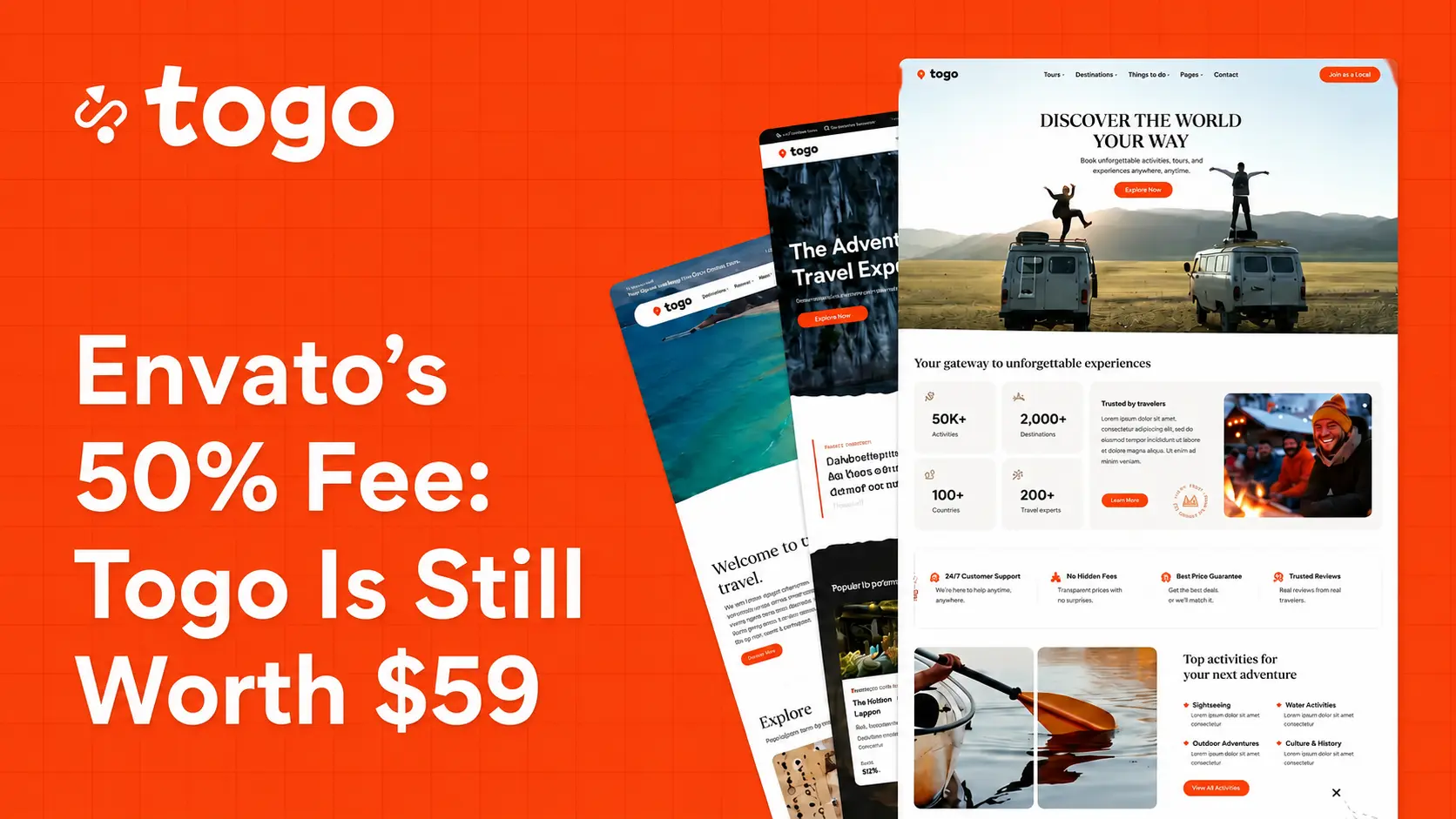
You may have seen the news circulating in the WordPress community this week: Envato has ended its exclusive author model and moved all ThemeForest and CodeCanyon sellers to a flat 50% author fee, effective July 2026.
It’s significant news for theme developers. It’s prompted sharp reactions across the WordPress ecosystem. And if you’re a Togo customer — or considering becoming one — you may be wondering what it means for you.
The short answer: almost nothing changes for buyers. But the longer answer is worth understanding, because it reveals something important about the economics of marketplace software and why owning your tools matters more than ever.
What Envato Actually Changed
The old ThemeForest model worked like this: Envato took a fixed “buyer fee” off the top of every purchase, then charged the author a percentage of the remaining “item price.” For established exclusive authors — developers who sold only through Envato — that author fee could be as low as 12.5%. In exchange for exclusivity, authors kept the majority of each sale.
Under the new July 2026 model, Envato has removed the exclusive author advantage entirely and pushed everyone to the same 50% author fee.
The math on a $79 theme purchase is stark. On a $79 WordPress theme sale with a $12 fixed buyer fee, a top exclusive author used to keep about $58.62. Under the new model, that same sale leaves about $33.50. The author loses about $25.12 per sale — before writing a line of code, answering a support ticket, or shipping an update.
The author’s share drops from roughly 74.2% to 42.4% of the customer’s payment. For theme developers who built their business around the old exclusive economics, this isn’t a small adjustment. It’s a fundamental reset.
Why Theme Developers Are Upset (And Rightfully So)
The percentage hurts, but the history makes it worse. Envato trained authors to treat exclusivity as the serious path. Authors put products, support systems, documentation, customer education, demos, and release cycles inside that marketplace because the exclusive rate made the trade-off defensible.
Now Envato is basically saying: you are free to sell elsewhere, but the marketplace cut gets much heavier anyway. That shows the real risk: the platform owns the rules. If your product business depends on a marketplace payout table, your margin is not yours. It is rented.
The community reaction has been pointed. Some authors are calling the change daylight robbery. Others are accelerating plans to build direct sales channels. The more measured voices are noting that Envato still drives real traffic and discovery — but that depending on it exclusively is now clearly the wrong strategy.
Notably, Envato’s original announcement on its Author Hub now returns a 404. The timing, as one observer put it, is either a coincidence or convenient.
What This Means for Togo Customers
Here’s the most important thing to understand: the price you paid for Togo does not change. The product you received does not change. Your license does not change.
When you purchase a theme on ThemeForest, you’re buying a license to use the product — not a subscription to the author’s revenue share arrangement with Envato. Whatever Envato charges the developer has no bearing on what you paid, what you received, or what you’re entitled to as a customer.
Your Togo license includes:
- The theme itself and all bundled plugins
- Free updates forever — new features, compatibility fixes, and template additions
- 6 months of professional support from the Togo team
- Access to all existing demo designs
None of that is affected by Envato’s fee restructuring.
What This Does Mean — For the Broader Ecosystem
While nothing changes for existing customers, Envato’s move does have real implications for the WordPress theme market that are worth understanding.
Prices may rise on ThemeForest.
When authors take home 42 cents on the dollar instead of 74 cents, some will raise prices to maintain margin. A theme that sold for $69 might move to $79 or $89. This is a predictable market response — not gouging, just economics.
More authors will sell direct.
Authors who build their own search footprint, publish on their own domain, and make their product pages discoverable through Google and AI search reduce their dependence on Envato’s marketplace listing. Expect to see more premium WordPress themes available directly from developer websites in the months ahead.
Support quality is at risk for some products.
A 43% cut in per-sale revenue means less budget for support staff, documentation updates, and ongoing development. Not every theme author will absorb this equally — developers with tight margins may reduce support responsiveness or slow update cycles. This is worth watching when evaluating any ThemeForest product going forward.
The case for direct purchase strengthens.
For WordPress product sellers, direct sales need two pieces: a Merchant of Record and a WordPress licenser. The Merchant of Record handles the payment layer — checkout, VAT/GST/sales tax, refunds, disputes. The licenser handles license keys, site activations, update eligibility, and protected downloads. More authors are building this infrastructure now — which ultimately means more options for buyers outside the ThemeForest marketplace.
Why $69 for Togo Is Still One of the Best-Value Purchases in WordPress
Step back from the Envato fee debate and look at what a $69 Togo license actually delivers:
- A complete travel booking platform — multi-vendor marketplace, real-time availability, WooCommerce payments, 50+ Elementor widgets, visa service module, 10+ demo designs, and SEO schema markup built in. No paid plugins required.
- No subscription fees. No revenue share on your bookings.
Compare that to the alternatives:
- A custom-built travel booking platform: $15,000–$50,000+ upfront, plus ongoing maintenance
- FareHarbor: 6% per booking, indefinitely — on $150,000 in annual bookings, that’s $9,000/year
- Bokun: $49–$249/month plus transaction fees — $1,800–$3,600/year before a single booking
Whatever Envato takes from the developer’s side of the transaction, the buyer’s value calculation doesn’t change. You paid $69 for something worth dramatically more in equivalent functionality. That equation holds regardless of how Envato and theme authors divide the revenue.
What to Do If You’re Still Considering Buying Togo
If you’ve been evaluating Togo and the Envato news gave you pause — the right question to ask isn’t “what does Envato’s fee change mean for me as a buyer?” It’s “does Togo still deliver what I need at the price being asked?”
The answer to that question hasn’t changed. Togo is still the most complete travel booking theme on ThemeForest, at a price point that no SaaS alternative comes close to matching.
If you want to buy Togo outside of ThemeForest at some point in the future, watch the Togo website directly — as more authors explore direct sales channels in response to Envato’s changes, direct purchase options may become available.
For now, ThemeForest remains where Togo is sold. The fee restructuring is a developer-side issue. Your $69 license is unaffected.
The Bigger Lesson: Own Your Platform
The Envato situation illustrates something that applies as much to theme buyers as it does to theme sellers: dependency on a single platform is a risk.
Envato changed its rules overnight, and thousands of developers woke up to significantly different economics. The parallel for travel agencies is direct: build your booking business on FareHarbor and FareHarbor can change its commission rates, its terms, or its existence. Build it on a platform you own — your WordPress site, your WooCommerce installation, your Togo theme — and no external policy change can restructure your revenue overnight.
This is the argument for owning your tools, not renting them. It applies to theme developers dealing with Envato. It applies to tour operators dealing with OTAs. The principle is the same: platforms own the rules. The only way to protect yourself from rule changes is to own as much of your stack as possible.
Togo, at $69 with a perpetual license, is a step in that direction.