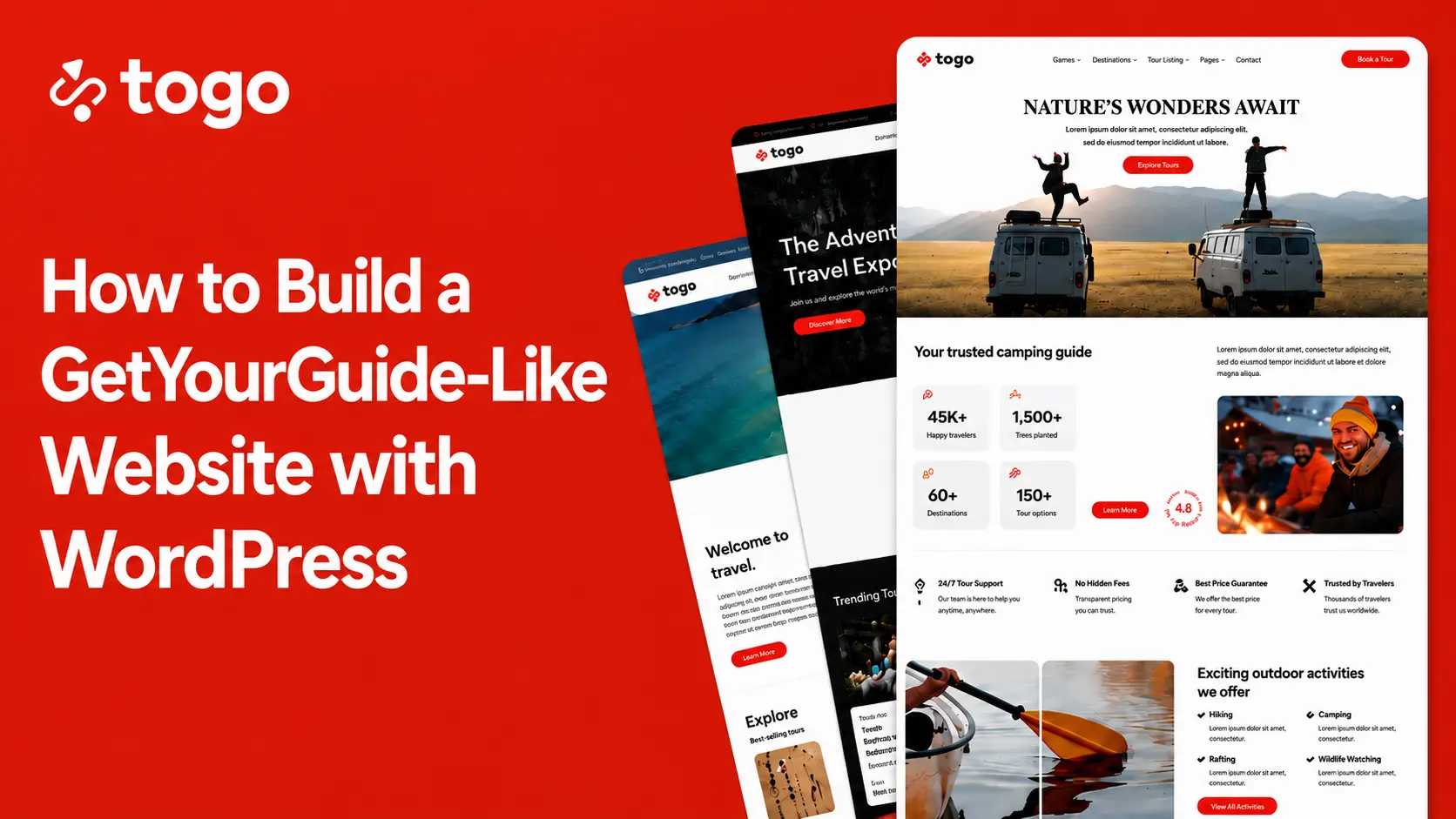
GetYourGuide is worth over $2 billion. It lists more than 100,000 experiences across 10,000+ destinations. Its engineering team has hundreds of developers. Its platform took years and tens of millions of dollars to build.
You are not going to replicate GetYourGuide.
But here’s what most people miss: you don’t need to.
GetYourGuide’s moat isn’t its technology. Technology that cost $50 million to build in 2012 costs $59 in 2026. GetYourGuide’s moat is its brand, its marketing budget, and its decade of SEO compounding. The platform architecture — a marketplace where travelers discover and book experiences from multiple operators — is completely replicable today, by a single person, on a weekend.
This guide shows you exactly how to do it.
What Makes GetYourGuide Work (And What You’re Actually Building)
Before building anything, understand what GetYourGuide actually is at a structural level — because this determines what you need to replicate.
GetYourGuide is a two-sided marketplace:
- Supply side: Tour operators and experience providers list their products on the platform. They get distribution — access to GetYourGuide’s audience — in exchange for a commission (typically 20–30% per booking).
- Demand side: Travelers discover, compare, and book experiences through the platform. They get convenience — one place to find vetted experiences across any destination.
The platform sits in the middle, facilitating the transaction and earning its commission without operating a single tour itself.
This is the model you’re building. Not GetYourGuide’s scale — but the same structural architecture, in your niche, in your destination, with your operators.
The strategic advantage of going niche is real: GetYourGuide tries to cover everything everywhere. A marketplace focused on adventure tours in Vietnam, culinary experiences in Mexico City, or sailing tours in the Greek islands can out-serve GetYourGuide in that niche because it’s more curated, more trusted, and more relevant to the specific traveler looking for exactly that experience.
What Your Platform Needs
A functional GetYourGuide-style marketplace requires seven core capabilities. Here’s what each one is and how Togo delivers it:
1. Multi-Vendor Tour Listings
Operators need to list their own tours independently — with photos, descriptions, pricing, itineraries, and availability — without requiring your manual intervention for each listing.
Togo delivers this through its Marketplace Plugin, which gives each vendor a self-serve dashboard to create and manage their own tour listings. You approve vendors before they go live; after that, they manage their own catalog.
2. Traveler-Facing Search and Discovery
Travelers need to find experiences by destination, category, date, price range, duration, and other filters — the same way they search on GetYourGuide.
Togo delivers this through an advanced search system with radius-based location search, category and tag filtering, date availability, price range sliders, and a tour archive that can be organized by destination, activity type, or operator. Togo’s 50+ Elementor widgets let you build custom discovery pages — destination hubs, category landing pages, featured collections — without touching code.
3. Real-Time Availability and Booking
Travelers need to see live availability and complete bookings instantly — no “send us an inquiry” forms, no waiting for manual confirmation.
Togo delivers this through a real-time availability calendar integrated into every tour listing, with instant booking confirmation through WooCommerce. Operators manage their own availability and capacity; the system prevents overbooking automatically.
4. Automated Commission Management
Every time a booking is made through your platform, your commission needs to be calculated and recorded automatically — you can’t manually track commissions across dozens of operators.
Togo delivers this through its Marketplace Plugin commission system. You set a platform-wide commission rate (or custom rates per vendor), and the system calculates and records your earnings on every transaction automatically.
5. Operator Dashboards
Each operator needs their own private dashboard where they can manage listings, view bookings, track earnings, communicate with travelers, and handle availability — without seeing other operators’ data.
Togo delivers this with individual vendor dashboards that are isolated per operator. Each vendor logs in and sees only their own business — their tours, their bookings, their commission statements.
6. Traveler Accounts and Booking History
Travelers should be able to create accounts, view their booking history, manage upcoming trips, and save experiences to a wishlist — the basic account functionality that builds repeat usage.
Togo delivers this through its user dashboard system — a complete account area with booking history, wishlist, and (if you offer it) visa application tracking.
7. Reviews and Social Proof
Traveler reviews on individual experiences are fundamental to marketplace trust. No GetYourGuide-style platform works without a credible review system.
Togo delivers this with a built-in review system that attaches verified reviews to individual tour pages and operator profiles. Reviews are tied to completed bookings, which prevents fake reviews and increases credibility.
How to Build It: Step-by-Step
Step 1: Define Your Niche
The biggest mistake aspiring marketplace builders make is starting too broad. “Tours worldwide” is not a niche. It’s a direct competition with GetYourGuide, Viator, and Klook — three platforms with billion-dollar marketing budgets.
Pick a niche you can own:
- Geographic niche: A marketplace exclusively for experiences in Bali, Patagonia, or the Scottish Highlands
- Activity niche: A platform for adventure sports experiences, culinary tours, or sustainable eco-tours globally
- Audience niche: A marketplace for solo female travelers, family experiences with young children, or accessible tours for travelers with disabilities
- Combination: Adventure tours in Southeast Asia for solo travelers
Your niche determines your operator outreach list, your SEO content strategy, and your marketing channels. Be specific enough to win, broad enough to build a real business.
Step 2: Install and Configure Togo
Purchase Togo ($59 on ThemeForest) and install it on a managed WordPress host — Kinsta, WP Engine, or SiteGround are reliable options. Install the three included plugins: Togo Framework, Elementor, and Contact Form 7.
Import the Tour Directory demo — it’s designed specifically for the marketplace layout, with vendor listing pages, operator profile templates, destination hubs, and a homepage built to showcase multiple operators rather than a single agency.
Configure core settings:
- Google Maps API key for destination search and maps
- WooCommerce for payment processing — connect Stripe for card payments and PayPal as an alternative
- Togo Marketplace Plugin — activate vendor registration, set your default commission rate, and configure vendor dashboard pages
- Tour archive slug — set this before creating any listings; /experiences/, /tours/, or /activities/ are all clean options
- User account pages — create and assign My Account, Booking History, and Wishlist pages
Step 3: Build Your Core Pages
Before onboarding any operators, build the pages that make your marketplace feel like a real platform:
Homepage: A marketplace homepage is different from an agency homepage. It should communicate the breadth of what’s available — destination categories, featured operators, recently added experiences, activity types — rather than a single brand story. Use Togo’s Elementor widgets to build a dynamic homepage that updates automatically as new listings are added.
Destination pages: Create a landing page for each destination you cover. These become your highest-traffic SEO pages over time — they rank for broad destination queries and funnel that traffic into specific operator listings. Build them before you have operators; populate them as vendors join.
Category pages: An “Adventure Tours” page, a “Culinary Experiences” page, a “Cultural Tours” page — category hubs that help travelers browse by interest rather than just geography.
How It Works page: Explain the marketplace to both audiences — travelers (how to find and book experiences) and operators (how to list and sell tours on your platform). This page reduces friction for both sides and increases conversion.
List Your Experience page: A dedicated page for operator acquisition — the benefits of listing on your platform, your commission rate, what support you provide, and a clear call-to-action to apply. This page does your B2B sales work for you.
Step 4: Onboard Your First Operators
Your marketplace has no value without supply. Before you launch publicly, onboard a minimum of 10–15 operators with genuine, high-quality listings. A marketplace with three tours feels empty; one with fifteen feels like a real platform.
Where to find your first operators:
- Direct outreach: Research tour operators in your niche who don’t have strong online booking capabilities. LinkedIn, Google searches for “[destination] tour operator”, local tourism boards. Send a short, personal email — explain your platform, your commission rate, and the distribution you offer.
- Existing networks: If you’ve worked in travel, hospitality, or your target destination, your existing relationships are your fastest path to initial supply.
- Tourism boards and associations: Many regional tourism organizations maintain directories of licensed operators. These are warm leads — operators who are already organized and looking for distribution channels.
For your first 10 operators, consider waiving the commission for the first 3 months. Getting quality supply on the platform early is worth more than the commission revenue from a small number of early bookings.
Step 5: Launch Your SEO Content Strategy
A marketplace generates SEO value in ways a single-operator site never can — because every new operator listing, every destination page, and every category hub adds indexed content that can rank independently.
Build your content strategy around three layers:
Destination content: For every destination you cover, publish a comprehensive travel guide — best time to visit, how to get there, neighborhoods, logistics, what makes it special for your niche. These pages rank for broad destination queries and build authority for your more specific tour listing pages.
Category content: “Best Cooking Classes in [City]”, “Top Snorkeling Tours in [Destination]”, “Beginner-Friendly Hiking Tours in [Region]” — listicle-style content that ranks for high-intent searches and links to relevant operator listings.
Operator features: Profile articles about specific operators on your platform — their story, their tours, what makes them distinctive. These rank for operator name searches and build trust with travelers considering their tours.
This content strategy compounds: the more destinations you cover and operators you feature, the more organic traffic you attract, which attracts more operators, which generates more content. This is the flywheel that makes marketplaces defensible over time.
Step 6: Set Up Your Commission and Payout System
Your commission system needs to be transparent to operators and automatic in its operation. Define and communicate:
- Commission rate: 10–20% is standard for niche marketplaces; higher than GetYourGuide’s typical 20–30% OTA rate is acceptable if you offer better terms and more targeted traffic
- Payout schedule: Monthly payouts are standard; some operators prefer bi-weekly
- Payout method: Bank transfer, PayPal, or Wise for international operators
- Refund policy: What happens to your commission when a traveler cancels? Define this clearly in your operator agreement
Document everything in a simple Operator Agreement that vendors sign before listing. This protects both parties and sets clear expectations from the start.
What You Can Charge Operators (And What the Math Looks Like)
Let’s run the economics of a niche marketplace at different stages of growth.
Year 1 — 20 operators, average $3,000/month in bookings per operator, 15% commission: Monthly revenue: $9,000 | Annual: $108,000
Year 2 — 50 operators, average $5,000/month, 15% commission: Monthly revenue: $37,500 | Annual: $450,000
Year 3 — 100 operators, average $6,000/month, 15% commission: Monthly revenue: $90,000 | Annual: $1,080,000
These aren’t guaranteed numbers — they’re illustrations of the model’s economics. The platform doesn’t get harder to run as it scales. Your commission revenue grows with operator volume and booking value; your operational costs don’t scale at the same rate.
This is the fundamental difference between a marketplace and an agency: revenue scales without proportional cost scaling.
The Honest Limitations
Building a GetYourGuide-style marketplace with Togo gets you the platform. What it doesn’t get you is GetYourGuide’s brand recognition, marketing budget, or decade of SEO.
The hardest part of building a marketplace isn’t the technology — it’s solving the chicken-and-egg problem. Travelers won’t come until there are operators. Operators won’t list until there are travelers.
The solution to this problem is always the same: start with supply. Onboard operators first, even before you have traveler traffic. Give them a reason to list (free commission period, guaranteed placements, personal relationships) that doesn’t depend on traveler volume. Then build the demand side through SEO content, targeted marketing, and operator referrals.
Niche focus is your most powerful tool for solving this problem. In a niche, the supply side is manageable (100 adventure operators in Patagonia, not 100,000 globally), and the demand side is targetable (adventure travelers researching Patagonia, not all travelers everywhere).
Your GetYourGuide Alternative Starts at $59
The technology that powers a tour and experiences marketplace is no longer a competitive moat. It’s a commodity — available to anyone willing to spend $59 on a WordPress theme and a weekend on setup.
What remains scarce is the combination of the right niche, genuine operator relationships, and a content strategy that compounds over time. Those are the things GetYourGuide can’t sell you — and they’re the things that will determine whether your marketplace succeeds.
Togo gives you the platform. The rest is yours to build.
Get Togo and launch your marketplace →
Explore the live marketplace demo to see exactly what you’d be launching.