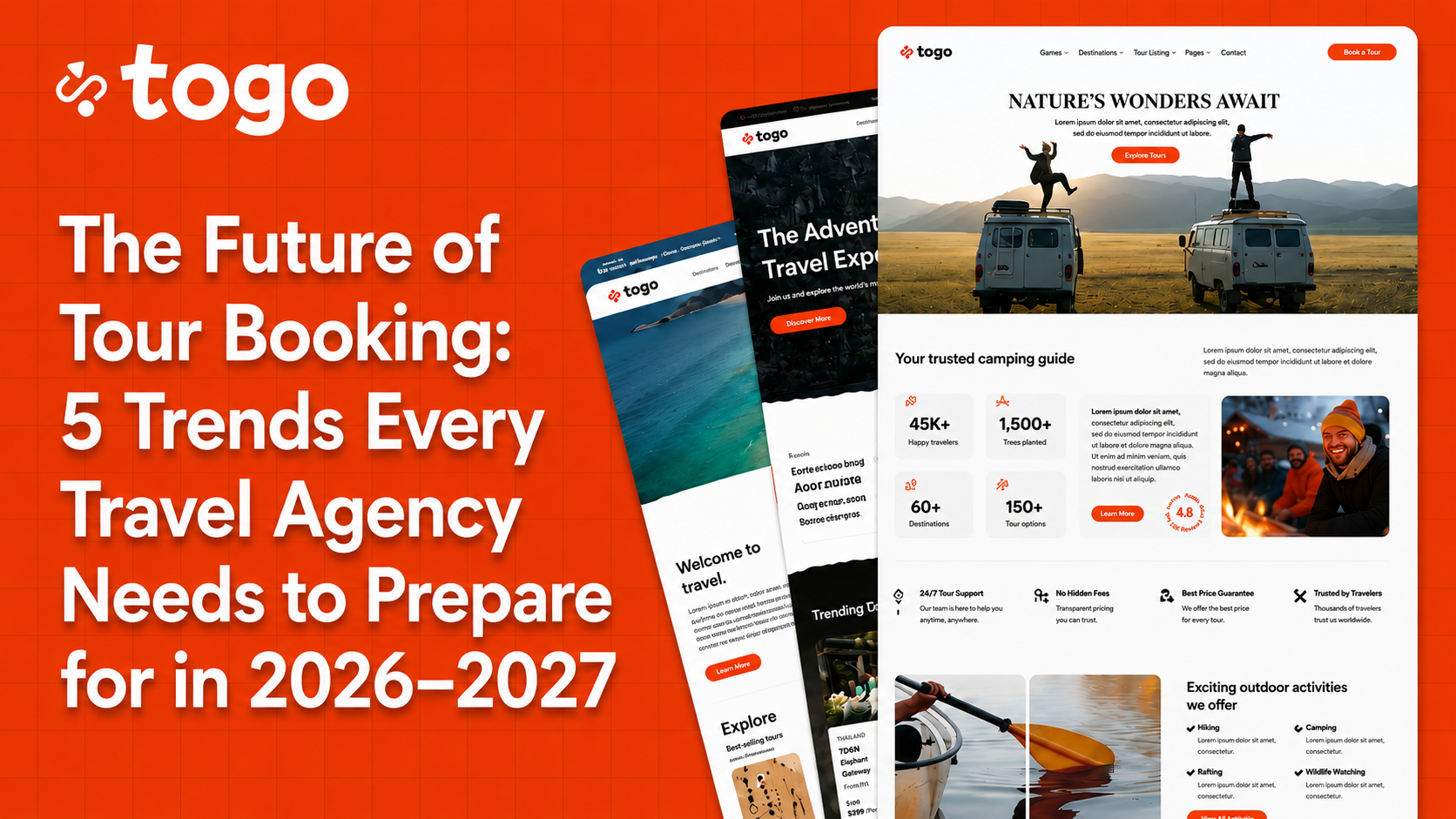
The travel industry has always been shaped by forces outside any single operator’s control — economic cycles, consumer sentiment, technology shifts. But the pace of change in 2026 is different. Several structural trends are converging simultaneously, and the gap between agencies that adapt and agencies that don’t is widening faster than at any point in the last decade.
This isn’t a prediction piece about distant futures. These trends are happening now. Some of your competitors are already responding to them. The question is whether you’re building a business designed for 2026’s reality — or one designed for 2019’s.
Here are five trends reshaping tour booking in 2026 and 2027, and what each one means for how you run your business.
Trend 1: The Death of the Generic Tour — Experience Economy Goes Mainstream
The shift has been building for years, but 2026 is the year it becomes impossible to ignore: travelers are no longer buying destinations. They’re buying experiences.
The data is consistent across every major travel research report: spending on experiences — activities, tours, cultural immersion, adventure, culinary exploration — is growing faster than spending on flights and accommodation. The post-pandemic traveler, having been reminded of mortality and the value of presence, allocates budget differently. They’ll stay in a modest hotel if it means they can afford the exceptional cooking class, the private guide to the local market, the sunrise trek with a small group.
What’s changing in 2026 is that this preference is hitting the mainstream. It’s no longer the behavior of affluent or adventurous travelers — it’s the expectation of the average traveler.
What this means for your agency:
Generic tours — “City Highlights Tour,” “Historical District Walking Tour” — are facing increasing competition from operators who have defined a sharper, more memorable experience. The operators winning in 2026 are the ones who can answer the question “why this tour, with this operator, rather than any of the alternatives?” with something specific and compelling.
Audit your tour catalog with this lens: which tours have a genuine, defensible identity? Which are generic enough that a traveler could find an equivalent anywhere? Invest in making your best tours more distinctive — a unique access point, a local expert guide with a personal story, a format no competitor offers in your destination.
On your website, sell the experience first and the logistics second. Your tour pages should open with the emotional promise — what will this person feel, see, understand, or achieve — before listing meeting times and included meals.
Trend 2: Direct Booking Is Winning (And OTA Fees Are Accelerating the Shift)
OTAs — Viator, GetYourGuide, Klook, Expedia — were supposed to be a distribution channel. For many operators, they’ve become the primary channel, and the terms have shifted accordingly. Commission rates that started at 15–20% have crept to 25–30% on some platforms. Ranking algorithms favor operators who advertise within the platform. The OTA owns the customer relationship, the review data, and the rebooking opportunity.
The economics are becoming unsustainable for small and mid-sized operators. A 28% commission on a $150 tour leaves $108 before your operational costs. When that same tour booked directly generates $150, the math of building a direct booking capability becomes obvious.
Travelers are also increasingly motivated to book directly. Sustainability-conscious travelers know that OTA fees mean less money reaches the local operator. Travelers who’ve had poor experiences with OTA customer service prefer the accountability of a direct relationship.
What this means for your agency:
The most valuable thing you can build in 2026 is a direct booking channel — a professional website, an email list, and an SEO presence that generates bookings without paying 25–30% to an intermediary.
This doesn’t mean abandoning OTAs. They remain a legitimate source of new customer discovery, particularly for travelers who haven’t yet heard of you. The strategic shift is treating OTAs as an acquisition channel — where travelers find you for the first time — and converting those customers into direct relationships for repeat bookings.
Collect email addresses from every OTA booking where platform rules permit. Build a post-tour follow-up sequence that directs customers to your website for their next trip. Offer a modest direct booking discount (5–10%) that undercuts the OTA price while still improving your margin significantly.
Your website is the foundation of your direct booking strategy. If it’s not professional, fast, and conversion-optimized, the strategy doesn’t work — travelers will default back to the OTA they already trust.
Trend 3: Last-Minute Booking Is Becoming the Norm
For most of travel history, operators could count on a reliable advance booking window — tours filling up weeks or months ahead of departure. That window has been compressing steadily, and in 2026, a significant portion of tour bookings are happening within 72 hours of departure.
Several forces are driving this. Mobile booking has removed the friction from last-minute decisions — a traveler already in your destination can find and book a same-day tour in under two minutes. AI travel planning tools are enabling travelers to finalize itineraries on the fly rather than months in advance. A generation of travelers who’ve grown up with on-demand everything is less inclined to plan far ahead.
For operators used to full manifests two weeks out, this requires operational adaptation. For operators who respond intelligently, it’s an opportunity.
What this means for your agency:
Your booking system needs to handle same-day and next-day bookings seamlessly — including on mobile. If your cutoff time for bookings is 48 hours before departure, you’re excluding an increasing proportion of potential customers. Test whether you can operationally support a shorter cutoff (24 hours or less) for at least some of your tours.
Dynamic pricing becomes more valuable in a last-minute booking environment. Tours with remaining availability two days out can be priced at a modest discount to fill seats that would otherwise go empty. Tours that consistently fill early can be priced higher to capture the value of advance commitment. Togo’s booking system supports dynamic pricing rules that automate this without manual intervention.
Real-time availability display — showing travelers exactly how many spots remain for each date — is also critical. Last-minute bookers are motivated by genuine scarcity. “3 spots remaining for tomorrow” converts. A static “Book Now” button doesn’t communicate the same urgency.
Trend 4: Sustainability Expectations Are Becoming Booking Criteria
Sustainable travel has been discussed as a trend for a decade. What’s different in 2026 is that it’s shifted from a preference to a criterion — a growing segment of travelers, particularly from European and North American markets, actively filter out operators who can’t articulate a credible sustainability position.
This isn’t purely altruistic. These travelers have connected the dots: the overtourism that’s degrading the destinations they want to visit is partly the result of high-volume, low-footprint tourism. They want to travel in a way that doesn’t contribute to the problem. They’re willing to pay more for operators who share that perspective — and willing to book elsewhere if they can’t find evidence of it.
The sustainability credentials that matter to this traveler segment are specific, not vague:
- Small group sizes (not just “intimate experience” marketing copy, but actual caps of 8–12 people)
- Local guides employed directly, not contracted through aggregators
- Local food and accommodation partners, not international chains
- Carbon offset programs with named, verified partners
- Community benefit — specific evidence that tour revenue reaches local people
What this means for your agency:
If you’re operating sustainably, you need to say so — specifically, not vaguely. A “We Care About the Environment” section with a generic stock photo of a forest is worse than nothing. What’s the maximum group size on your tours? Who are your local partners? What percentage of your guide team is from the local community?
Build a dedicated Sustainability page on your website. Be specific. Name the things you do and why. This page serves two purposes: it resonates with sustainability-conscious travelers and filters out travelers who would be disappointed by a more immersive, small-group experience.
If you’re not yet operating sustainably in ways you can document, this is the year to start. The segment of travelers who prioritize sustainability is large, growing, and willing to pay a premium — a combination that makes it one of the most commercially attractive traveler segments to serve.
Trend 5: AI Is Changing How Travelers Discover Tours — And What They Expect
In 2024, travelers Googled. In 2026, a meaningful and growing percentage of travel planning begins with an AI assistant — ChatGPT, Perplexity, Google’s AI Overview, and a growing ecosystem of travel-specific AI planning tools.
This changes discovery in ways that most travel operators haven’t fully processed yet. When a traveler asks an AI assistant “What’s the best cooking class in Chiang Mai for a solo traveler?”, the AI synthesizes information from across the web — reviews, blog posts, travel guides, your own website — and generates a recommendation. The traveler may never visit the traditional search results page at all.
The operators who show up in AI recommendations are the ones with the richest, most consistent digital footprint: detailed tour descriptions, genuine reviews across multiple platforms, mentions in travel blog content, active social proof. The operators who don’t show up are the ones who built a website and stopped there.
AI is also changing what travelers expect when they arrive on a tour website. Having received a personalized, conversational recommendation from an AI assistant, they arrive expecting an experience that matches that quality. A static, templated website with thin tour descriptions feels like a step backward.
What this means for your agency:
Your content strategy needs to think beyond Google search. The signals that make you visible to AI discovery are the same signals that make you rank well in traditional search — but the content depth required is higher. AI assistants synthesize from longer-form content; a 300-word tour description gives them less to work with than an 1,200-word one with structured itinerary details, FAQ content, and genuine specificity about what makes your tour distinctive.
Reviews matter more than ever in an AI-discovery world. AI assistants heavily weight review sentiment and volume when generating recommendations. Building a systematic review collection process — post-tour emails, gentle follow-ups, making the review process as frictionless as possible — is no longer optional for operators who want to grow.
Consider adding a simple AI chat widget to your website that can answer common pre-booking questions. Travelers who’ve been interacting with AI assistants throughout their planning process will naturally reach for a chat interface over a contact form. This reduces pre-booking friction and captures inquiries that might otherwise be abandoned.
The Common Thread
Five different trends, one common implication: the travel agencies that thrive in 2026 and 2027 are the ones that own their digital presence.
A distinctive experience identity requires a website where you can tell your story. A direct booking strategy requires a platform you control. A last-minute booking capability requires a booking system that handles real-time availability. Sustainability credentials require content depth and specificity. AI discovery requires a rich, authoritative content footprint.
All of these point toward the same investment: a professional, well-built, content-rich travel website that you own outright — not a widget embedded in someone else’s platform, not a marketplace listing where you’re one of hundreds, not a social media profile that changes its algorithm without warning.
Togo is built for exactly this moment — a platform that gives independent travel operators and agencies the technical foundation to compete in a market that increasingly rewards authenticity, depth, and direct customer relationships.
Build your future-proof travel platform with Togo →
Related reading: How to Get Your Tour Website on Page 1 of Google