Klook processes over 10 million bookings per month. It’s the dominant activities and experiences platform across Southeast Asia, Northeast Asia, and the broader Asia-Pacific region — the go-to booking platform for travelers across Thailand, Vietnam, Indonesia, the Philippines, Japan, South Korea, Hong Kong, and Taiwan.
What Viator is to Western travelers, Klook is to Asian travelers. And the Asian travel market is not a secondary opportunity. Asia-Pacific is the fastest-growing travel region in the world, with inbound and domestic travel demand that dwarfs most Western markets in sheer volume.
Here’s the reality that makes this interesting for independent operators: Klook takes 20–30% commission on every booking. It owns the customer relationship. It owns the data. And it covers everything everywhere — which means it covers nothing particularly well anywhere.
A focused, niche marketplace built for Asian travelers — or for operators in a specific Asian destination — can out-serve Klook in that niche the same way a specialist always out-serves a generalist for the right customer.
This guide shows you how to build that platform with WordPress and Togo, designed specifically for the Asia market.
Understanding the Klook Model — What You’re Actually Replicating
Klook’s architecture is a standard two-sided marketplace:
- Supply side: Tour operators, activity providers, attraction ticket sellers, and transport operators list their products on the platform. They get access to Klook’s massive traveler audience in exchange for a 20–30% commission per booking.
- Demand side: Travelers — predominantly from China, South Korea, Japan, Taiwan, Hong Kong, Singapore, and Southeast Asia — discover, compare, and book activities through the platform, often on mobile, often the same day or day before the activity.
What makes Klook distinct from Western marketplace competitors like Viator and GetYourGuide is its mobile-first, Asia-first design philosophy:
- The majority of Klook bookings happen on mobile — its app has been downloaded over 50 million times
- It supports multiple Asian languages natively: Chinese (Simplified and Traditional), Japanese, Korean, Thai, Bahasa Indonesia, Vietnamese
- It integrates regional payment methods that Western platforms don’t support: Alipay, WeChat Pay, GrabPay, KakaoPay, Line Pay, and local bank transfer options across Southeast Asian markets
- Its customer service operates in local languages with local time zone coverage
- Its marketing is tailored by market — campaigns for Chinese New Year, Korean Chuseok, Japanese Golden Week
You don’t need to replicate all of this at launch. But understanding these design principles helps you build a platform that genuinely serves Asian travelers rather than a Western marketplace with an Asian flag on the homepage.
Why a Niche Klook Alternative Can Win
Klook’s scale is also its weakness. When a platform lists 100,000+ experiences across 1,000 destinations, curation becomes impossible. Travelers in search of authentic, high-quality local experiences increasingly find Klook overwhelming — too many options, inconsistent quality, no clear editorial voice.
The operators who win on Klook are the ones who invest heavily in Klook’s paid promotion system — which means smaller, higher-quality operators get buried unless they pay to surface. The platform increasingly rewards marketing spend, not product quality.
A niche marketplace solves this problem by design. If your platform covers adventure experiences in Vietnam, or cultural tours in Japan for Korean travelers, or halal-friendly tours across Southeast Asia — the curation is built into the premise. Every listing on your platform is there because it fits the niche. Every traveler who finds your platform is looking for exactly what you offer.
Niche ideas with genuine market demand:
- Adventure and outdoor experiences in Southeast Asia (Vietnam, Thailand, Indonesia, Philippines)
- Cultural and heritage tours in Japan for Chinese and Korean travelers
- Halal-friendly experiences across Muslim-majority Southeast Asian destinations
- Wellness and retreat experiences across Bali, Chiang Mai, and Sri Lanka
- Food and culinary tours in a single city or region
- Family-friendly experiences across Asia-Pacific for Singaporean and Hong Kong families
Pick a niche you understand, where you have operator relationships or can build them, and where the existing platforms serve the traveler poorly.
What Your Platform Needs — The Asia-Specific Requirements
A generic marketplace checklist applies here — multi-vendor listings, real-time booking, commission management, traveler accounts, reviews. Togo delivers all of these, as outlined in the GetYourGuide and Viator guides elsewhere on this blog.
What’s different for an Asia-focused platform are five additional requirements:
1. Mobile-First Design and Performance
Asian travelers book on mobile at significantly higher rates than Western travelers. In markets like China, Vietnam, and Indonesia, mobile is the primary internet device for the majority of users — not a secondary screen.
Togo is built mobile-first with responsive layouts optimized for touch interaction. But mobile-first design for Asian markets means going further than responsive CSS:
- Page load speed on mobile networks matters more than on desktop — compress every image aggressively (target under 150KB per image in WebP format)
- Booking flows should require minimal typing — date pickers, dropdown selectors, and pre-filled fields wherever possible
- The “Book Now” button should be visible without scrolling on every tour page on mobile
- Test your complete booking flow on an actual Android device on a 4G connection — not just an iPhone on WiFi
2. Multilingual Support
If your target audience includes non-English speaking Asian travelers — Chinese, Japanese, Korean, Thai, Vietnamese, Indonesian — a single-language English site leaves the majority of your potential market unable to use it.
WordPress supports multilingual sites through plugins like WPML or Polylang. Togo is compatible with both. For launch, prioritize the one or two languages most relevant to your niche:
- Targeting Chinese travelers? Simplified Chinese and Traditional Chinese (separate variants for mainland China vs. Taiwan/HK audiences)
- Targeting Korean travelers to Japan? Korean and Japanese
- Targeting Indonesian domestic travelers? Bahasa Indonesia
Machine translation is a starting point, not a solution — get native speakers to review translated tour pages and booking UI before launch. Awkward translations are a trust killer in Asian markets where travelers are particularly sensitive to platform credibility.
3. Regional Payment Methods
This is the single biggest technical gap between a generic WordPress booking site and a platform that actually converts Asian travelers.
Western payment methods — Stripe credit card, PayPal — work for international travelers with Western bank accounts. They don’t work for:
- Chinese travelers who primarily use Alipay and WeChat Pay
- Southeast Asian travelers who use GrabPay, GoPay, OVO, MoMo, or TrueMoney
- Japanese travelers who prefer convenience store payment (konbini) or JCB cards
- Korean travelers who use KakaoPay or local Korean card networks
WooCommerce — which powers Togo’s booking system — has payment gateway plugins for most of these methods:
- Alipay and WeChat Pay: Available through Stripe (which added both to its platform), or through dedicated WooCommerce plugins for each
- GrabPay: Available through Stripe in Singapore, Malaysia, Philippines, and Thailand
- Vietnam (MoMo, VNPay, ZaloPay): Available through local payment gateway providers like OnePay or VNPTepay with WooCommerce integration
- Indonesia (GoPay, OVO, Dana): Available through Midtrans WooCommerce plugin
- Japan (konbini, JCB): Available through GMO or SBPayment WooCommerce plugins
You don’t need all of these at launch. Identify the one or two payment methods most used by your primary traveler segment and integrate those first. Add more as you expand.
4. Same-Day and Last-Minute Booking Optimization
Asian travelers — particularly those traveling within Asia — book activities significantly closer to the activity date than Western travelers. Klook’s data consistently shows that a large proportion of bookings happen within 24 hours of the activity, with same-day booking common for city-based experiences.
Your platform needs to be optimized for this behavior:
- Set booking cutoff times to 2–4 hours before activity start where operationally feasible
- Display real-time availability prominently — “5 spots left for today” is a conversion driver
- Enable instant confirmation (not “pending approval”) for all listings
- Make sure your mobile booking flow can be completed in under 90 seconds — this is the benchmark for same-day mobile bookings
5. Trust Signals for Asian Travelers
Trust signals that convert in Western markets don’t always translate to Asian markets — and vice versa. Asian travelers, particularly from China, Japan, and Korea, are highly sensitive to social proof from within their own community.
Platform-level trust signals that matter in Asian markets:
- Review volume from travelers like them — a Japanese traveler is more influenced by Japanese reviews than by English reviews. If you can display reviews filtered by traveler nationality or language, this significantly improves conversion.
- Operator credentials — business registration numbers, tourism licenses, and professional certifications displayed prominently on operator profiles signal legitimacy in markets where scam operators are a real concern.
- Responsive customer service in local language — a visible WhatsApp number or LINE contact for customer support converts in Southeast Asian markets where these apps are the primary communication channel.
- Clear refund and cancellation policy — Asian travelers, particularly from Northeast Asia, are more risk-averse about online bookings. A visible, clear, fair cancellation policy reduces abandonment at checkout.
How to Build It: Step-by-Step
Step 1: Set Up Togo with the Tour Directory Demo
Purchase Togo ($59 on ThemeForest) and install it on a managed WordPress host with servers located in or near your target market — a Singapore or Tokyo data center serves Asian users significantly faster than a US or European server.
Import the Tour Directory demo and configure core settings: Google Maps API, WooCommerce, Togo Marketplace Plugin, tour archive slug, and user dashboard pages.
Full setup guidance is in our 30-Day Launch Guide.
Step 2: Configure Asia-Specific Payment Methods
Connect Stripe as your primary payment processor and enable the regional payment methods available through Stripe (Alipay, WeChat Pay, GrabPay) in your WooCommerce payment settings.
For payment methods not available through Stripe, install the relevant WooCommerce gateway plugin for your market and configure it separately.
Test every payment method with a real transaction before launch.
Step 3: Set Up Multilingual Support
Install WPML or Polylang and configure your primary language pair.
Translate your homepage, core navigation, booking UI, confirmation emails, and your five most important tour pages first. Add additional page translations progressively after launch.
Do not translate tour listing content automatically — operator listings should be submitted in the traveler’s language, or reviewed by a native speaker before publishing.
Step 4: Onboard Your First 15 Operators
Focus on operators in your niche who are already receiving bookings through Klook or other OTAs — they understand the marketplace model, they have existing tour products, and they’re motivated by the prospect of lower commission rates.
Your pitch to operators: same distribution model as Klook, lower commission (position yourself at 10–15% vs. Klook’s 20–30%), more targeted audience (your niche vs. Klook’s everything-everywhere approach), and no algorithm that buries them unless they pay for promotion.
For your first operators, offer a 3-month free commission period to accelerate supply-side growth. Getting 15 quality listings live before you drive traveler traffic is worth more than the commission revenue from early bookings.
Step 5: Build Destination Content in Your Target Language
Your SEO content strategy needs to target the search behavior of your traveler audience — which may not be English search.
If you’re targeting Korean travelers to Japan: Korean-language content about Japanese destinations, optimized for Naver (South Korea’s dominant search engine) as well as Google.
If you’re targeting Chinese travelers across Southeast Asia: Simplified Chinese content optimized for Baidu as well as Google.
If you’re targeting English-speaking Asian travelers (Singapore, Malaysia, Philippines, India): English content with Asia-specific keywords and destination focus.
Build destination hub pages for every location you cover, activity category pages for every niche you serve, and at least two long-form guides per destination at launch.
The Economics: What a Klook-Alternative Marketplace Earns
Running the numbers on a focused Southeast Asia adventure marketplace at three growth stages:
- Launch (20 operators, $2,000 average monthly bookings per operator, 12% commission): Monthly platform revenue: $4,800 | Annual: $57,600
- Growth (60 operators, $4,000 average monthly bookings, 15% commission): Monthly platform revenue: $36,000 | Annual: $432,000
- Scale (150 operators, $5,000 average monthly bookings, 15% commission): Monthly platform revenue: $112,500 | Annual: $1,350,000
The platform costs $59 to build and roughly $50/month to host. The gap between that and the revenue at scale is the entire value proposition of the marketplace model.
Start With One Market, One Niche, One Language
The temptation when building a Klook alternative is to go broad — multiple countries, multiple languages, multiple activity categories — from day one. Resist it.
Klook spent years and hundreds of millions of dollars expanding market by market, language by language, category by category. You have $59 and a weekend.
Pick one destination. One traveler nationality. One activity niche. Build the best possible marketplace for that specific combination. Win that niche before expanding.
The operators who build successful niche marketplaces in 2026 are the ones who go narrow first and let the platform’s success justify expansion — not the ones who try to out-Klook Klook from day one.
Get Togo and launch your Asia marketplace →
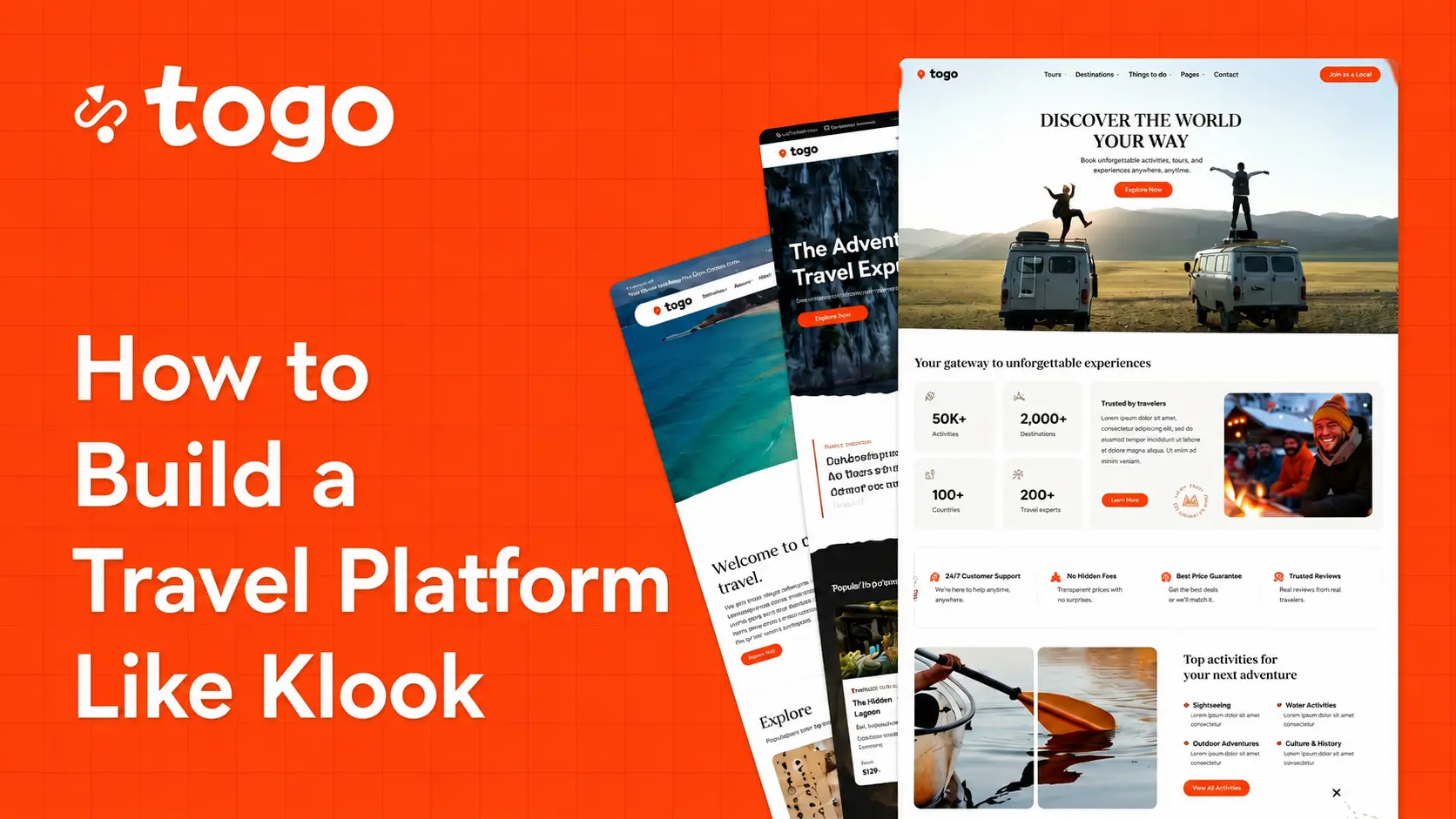
Explore the Tour Directory demo to see the marketplace layout in action.