Your booking system is the engine of your tour business. Get it right and you have a platform that scales with you for years. Get it wrong and you’re locked into a contract, paying escalating fees, and rebuilding from scratch twelve months later.
Three options dominate the conversation for tour operators in 2026: FareHarbor, Bokun, and WooCommerce (paired with a purpose-built travel theme like Togo). They each have real strengths. They each have real limitations. And the right choice depends entirely on where your business is now and where you’re trying to take it.
This is the comparison nobody in the industry wants to write honestly — because FareHarbor and Bokun pay referral commissions to people who recommend them. We don’t. So here’s the unfiltered version.
Quick Comparison Overview
| WooCommerce + Togo | FareHarbor | Bokun | |
|---|---|---|---|
| Setup cost | $59 (one-time) | Free | Free |
| Per-booking fee | $0 | 6% + payment processing | ~1.5% + payment processing |
| Monthly fee | $0 (hosting only) | $0 | $49–$249/month |
| You own the platform | ✅ Yes | ❌ No | ❌ No |
| You own the data | ✅ Yes | ❌ No | ❌ No |
| Multi-vendor marketplace | ✅ Yes | ❌ No | ❌ No |
| Custom design control | ✅ Full | ⚠️ Limited | ⚠️ Limited |
| Visa service module | ✅ Yes | ❌ No | ❌ No |
| Payment gateway choice | ✅ 100+ options | ⚠️ FareHarbor Payments | ⚠️ Limited |
| OTA channel management | ❌ Plugin required | ✅ Built-in | ✅ Built-in |
| Offline POS booking | ❌ Limited | ✅ Yes | ✅ Yes |
| Contract / lock-in | ❌ None | ⚠️ Yes | ⚠️ Yes |
FareHarbor: The Sales-First Booking Platform
FareHarbor is the market leader in tour booking software, and it earned that position. Its sales team is aggressive and effective, its onboarding is fast, and the core booking widget integrates cleanly into almost any existing website.
What FareHarbor does well
Fast deployment. FareHarbor can have a functioning booking system live on your website within days. Their implementation team does most of the technical setup for you — you don’t need to know WordPress or manage plugins.
Offline and in-person booking. FareHarbor’s dashboard and mobile app support walk-in and phone bookings, which matters for operators who take reservations through multiple channels.
Channel management. FareHarbor connects with major OTAs (Viator, GetYourGuide, Expedia) for inventory synchronization — one availability calendar that updates across all platforms automatically.
Reporting and manifest management. The dashboard is built for operations: daily manifests, guide assignments, capacity management, and booking reports are all handled cleanly.
Where FareHarbor falls short
The commission model compounds over time. FareHarbor charges approximately 6% per booking, passed to the customer as a “booking fee.” On a $100 tour, that’s $6. On a $500 tour, it’s $30. On $200,000 in annual bookings, it’s $12,000 — every year, indefinitely. That fee doesn’t buy you anything new; it’s the cost of staying on the platform.
You don’t own the platform or the data. Your booking system, your customer data, and your operational history live on FareHarbor’s servers. If FareHarbor changes its pricing, terms, or decides to compete with you directly, your options are limited.
Design control is minimal. The FareHarbor booking widget sits on your website as an embedded element — it looks like FareHarbor, not like your brand. Customization options are limited.
No marketplace capability. FareHarbor is built for single operators. If you want to run a platform where multiple vendors list tours, FareHarbor can’t do it.
Who FareHarbor is right for
Tour operators doing significant volume ($500K+ annually) who prioritize operational efficiency and OTA channel management over cost savings and platform ownership. If you’re running a high-volume, multi-channel operation and the 6% fee is a manageable cost of doing business, FareHarbor is genuinely excellent software.
Bokun: The Distribution-First Platform
Bokun is Viator’s booking platform — acquired by TripAdvisor in 2018 — and it’s built around distribution: getting your tours listed on as many channels as possible, as efficiently as possible.
What Bokun does well
OTA integration is its strongest feature. Bokun connects with 100+ distribution channels including Viator, GetYourGuide, Expedia, Klook, and dozens of regional OTAs. If your growth strategy is heavily OTA-dependent, Bokun’s channel management is best-in-class.
Booking engine quality. Bokun’s booking widget is clean, mobile-optimized, and handles complex tour configurations — multi-day tours, packages, add-ons — better than most alternatives.
Resource management. Guides, vehicles, equipment — Bokun tracks resource availability across bookings to prevent conflicts, which is genuinely useful for operators managing physical assets.
Where Bokun falls short
Monthly fees plus transaction fees. Bokun’s pricing starts at $49/month for basic features and scales to $249/month for the full platform. Add payment processing fees on top of that and the monthly cost of running Bokun is significant — before you’ve taken a single booking.
Viator conflict of interest. Bokun is owned by TripAdvisor, which also owns Viator. Some operators are uncomfortable with the idea that their booking platform is owned by a company that also competes for their customers through its OTA. It’s a legitimate concern worth considering.
Same ownership and data issues as FareHarbor. Your platform, your customer data, and your booking history belong to Bokun — not to you. Migrating off the platform is painful.
No marketplace, no custom design control, no visa module. Like FareHarbor, Bokun is a single-operator booking tool. It wasn’t designed for the platform business model.
Who Bokun is right for
Tour operators whose primary growth strategy is OTA distribution — operators who want to be on Viator, GetYourGuide, Klook, and every other major channel simultaneously, with one inventory system keeping everything in sync. If OTAs are your main sales channel, Bokun’s distribution network justifies the monthly fee.
WooCommerce + Togo: The Platform-Builder’s Choice
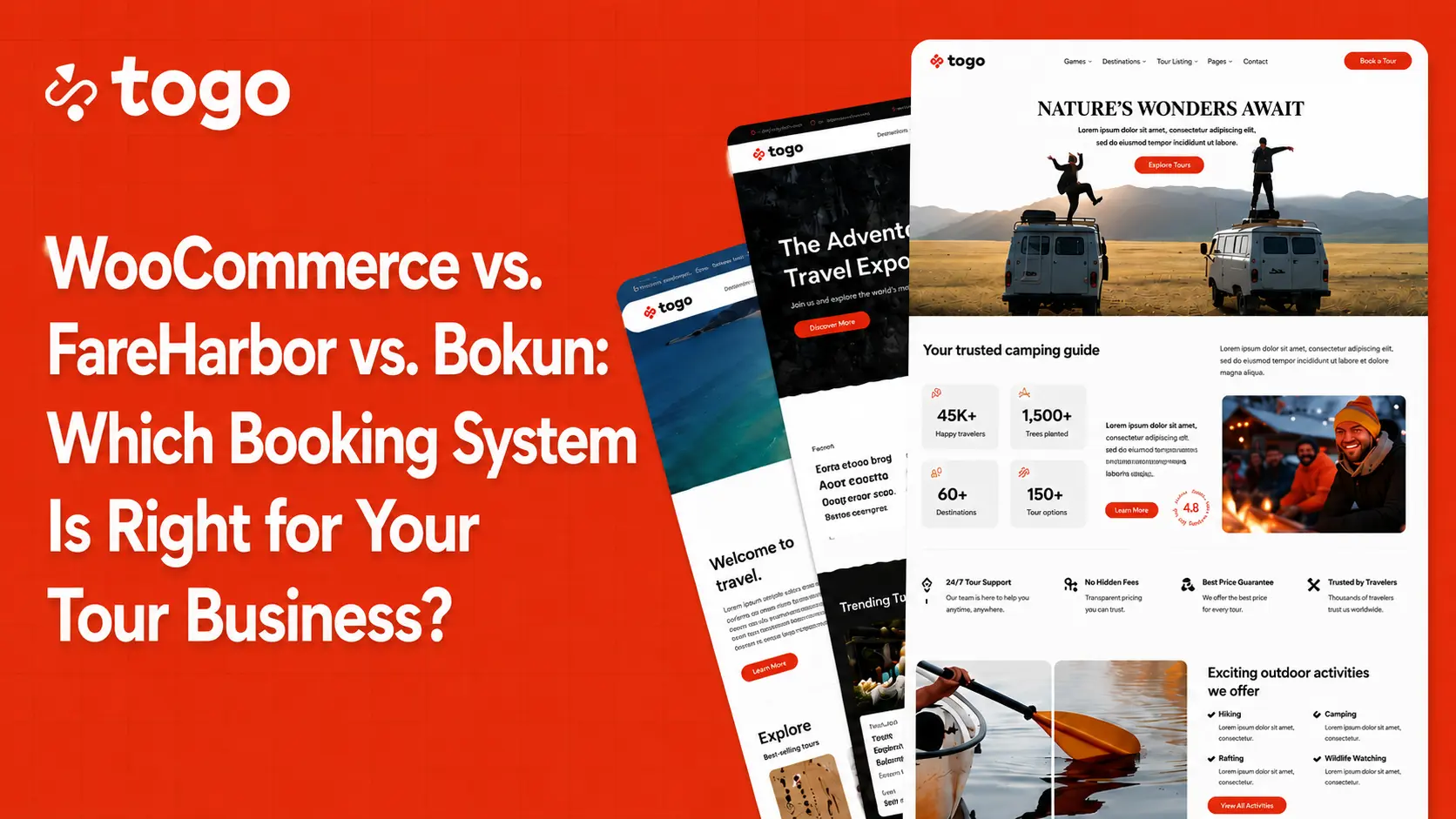
WooCommerce is the world’s most-used e-commerce platform, powering over 5 million online stores. Paired with Togo — a WordPress theme purpose-built for travel booking — it becomes a complete tour booking and marketplace platform that you own outright, with no per-booking fees and no vendor lock-in.
What WooCommerce + Togo does well
Total cost of ownership is dramatically lower. Togo costs $59 one-time. WooCommerce is free. Your only ongoing cost is hosting — typically $20–$50/month for a well-configured WordPress host. Compare that to FareHarbor’s 6% commission or Bokun’s $49–$249/month fee, and the math is stark over a 3-year horizon.
You own everything. Your website, your booking system, your customer data, your booking history, your SEO rankings — all of it sits on infrastructure you control. No platform can change its terms and hold your business hostage. No acquisition can suddenly change the cost structure you built your business on.
Multi-vendor marketplace. This is the capability that neither FareHarbor nor Bokun offers. Togo’s Marketplace Plugin lets you run a platform where multiple operators list and sell tours through your site, with automated commission tracking and vendor dashboards. It’s a fundamentally different business model — and a fundamentally higher revenue ceiling.
Complete design control. Your booking pages, tour listings, and checkout flow look exactly like your brand — because they’re built on your website with Elementor, not embedded widgets from a third-party system.
100+ payment gateway options. WooCommerce integrates with Stripe, PayPal, and dozens of regional payment processors. You’re not forced into a proprietary payment system with its own fee structure.
Visa services, digital products, featured listings. Togo supports revenue streams that FareHarbor and Bokun simply don’t — because they’re single-purpose booking tools, not platforms.
Where WooCommerce + Togo falls short
OTA channel management requires additional setup. If you want to sync inventory with Viator or GetYourGuide, you’ll need a channel manager plugin (like TourCMS or a direct API integration). This is solvable, but it’s not built-in the way Bokun handles it.
Offline and POS booking is more limited. WooCommerce can handle phone and walk-in bookings through the admin panel, but it’s less streamlined than FareHarbor’s dedicated operations dashboard.
You manage your own hosting and updates. There’s no “FareHarbor implementation team” — you or someone on your team is responsible for keeping WordPress, WooCommerce, and Togo updated. This is manageable with a good hosting environment, but it’s a real operational difference.
Who WooCommerce + Togo is right for
Tour operators and travel entrepreneurs who are building for the long term — who want to own their platform, control their costs, and have the flexibility to build a business that goes beyond a single-operator booking widget. If you’re thinking about a marketplace, multiple revenue streams, or simply not wanting to hand 6% of your revenue to a software company indefinitely, WooCommerce + Togo is the right foundation.
The Long-Term Cost Comparison
Let’s run the numbers on a tour business doing $150,000 in annual bookings over three years.
FareHarbor: 6% fee = $9,000/year = $27,000 over 3 years
Bokun: $149/month average = $1,788/year + ~1.5% transaction fee ($2,250) = $4,038/year = $12,114 over 3 years
WooCommerce + Togo: $59 theme + $360/year hosting = $419 year 1, $360 years 2–3 = $1,139 over 3 years
The difference isn’t marginal. At $150,000 in annual bookings, choosing WooCommerce + Togo over FareHarbor saves approximately $25,800 over three years. That’s money that stays in your business — available for marketing, staff, new tour development, or profit.
The Verdict
Choose FareHarbor if you’re doing high volume, need best-in-class operations management and OTA sync, and the commission fee is an acceptable cost of doing business at your scale.
Choose Bokun if OTA distribution is your primary growth channel and you need a dedicated channel manager with deep integration into the major OTA platforms.
Choose WooCommerce + Togo if you’re building a travel business for the long term — if you want to own your platform, control your costs, run a marketplace, and build a business that isn’t dependent on a third-party software company’s pricing decisions.
For most independent tour operators and travel entrepreneurs building in 2026, the choice is clear. Ownership compounds. Fees don’t.