Let’s do some uncomfortable math.
Say your tour business processes $150,000 in bookings per year through OTAs — Viator, GetYourGuide, TripAdvisor Experiences, Klook. At an average commission of 25%, you handed over $37,500 last year for the privilege of being listed next to your competitors.
That’s not a marketing expense. That’s a salary. That’s a second vehicle. That’s your entire off-season cushion — gone, every single year, forever, as long as OTAs remain your primary booking channel.
Here’s the part most operators don’t want to hear: OTAs are not the problem. Dependency is. OTAs are excellent at one thing — putting your tours in front of travelers who have never heard of you. The mistake is letting them also own the second, third, and fourth booking from customers who have heard of you.
This guide is about fixing that — systematically shifting bookings from rented channels to a channel you own.
Why Direct Bookings Are Worth Fighting For
The commission is the obvious reason, but it’s actually the smallest one. Direct bookings give you three things OTAs will never hand over:
1. The customer relationship. When someone books through Viator, they’re Viator’s customer. You often don’t get their email address, can’t market to them again, and can’t invite them back next season. On your own website, every booking builds an asset: a customer list you can email for free, forever.
2. Pricing control. OTA rate parity clauses and race-to-the-bottom discounting squeeze your margins from both ends. On your own site, you decide the price, the packages, the upsells, and the cancellation policy.
3. Immunity from algorithm changes. OTAs regularly change ranking algorithms, commission structures, and payout terms. Operators who depend on a single OTA for 80% of bookings are one policy update away from a very bad quarter.
The goal isn’t to abandon OTAs. It’s to change the ratio. A healthy tour business in 2026 might look like 40% OTA / 60% direct — using OTAs as a discovery engine while capturing repeat business, referrals, and search traffic on your own platform.
Step 1: Have a Website That Can Actually Take Bookings
This sounds obvious, but it’s where most operators fail before they start. A brochure website with a “Contact us to book” form is not a direct booking channel — it’s a lead form with a 90% drop-off rate.
Travelers who are used to booking on GetYourGuide in three taps will not email you and wait 12 hours for a reply. To compete with OTA convenience, your website needs:
- Real-time availability — travelers see open dates instantly
- Instant online payment — Stripe, PayPal, credit card, done in one session
- Automatic confirmation emails — the booking feels “real” immediately
- Mobile-first checkout — over 60% of tour bookings now start on a phone
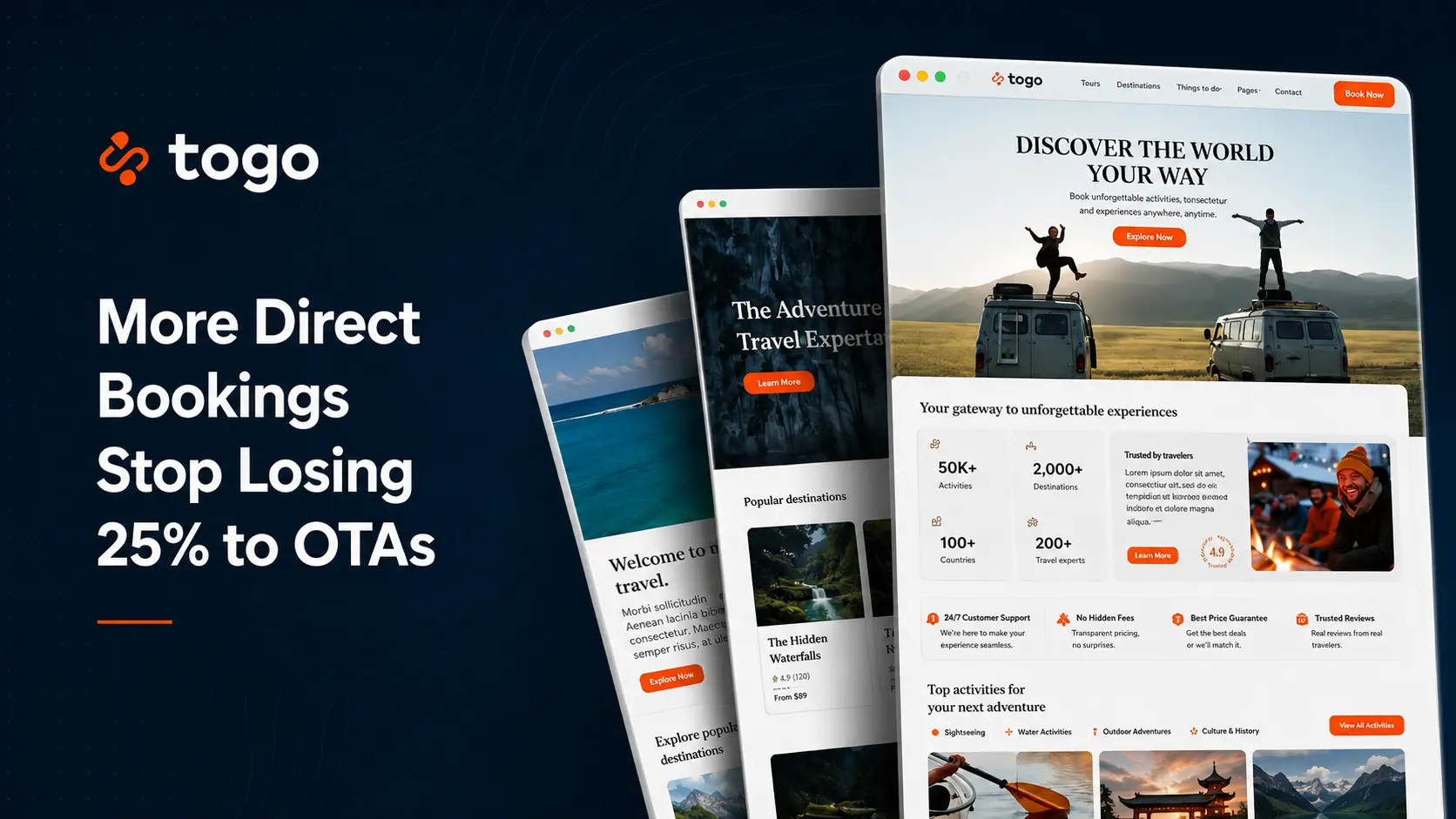
Building this used to require custom development or expensive SaaS booking systems charging their own per-booking fees (FareHarbor and friends take 6%+ from your customers). With WordPress and a purpose-built theme like Togo, the entire booking stack — availability calendar, payments, confirmations, customer accounts — comes built in for a one-time $59. No commission. No monthly fee. Every dollar of every booking stays with you.
If you haven’t launched yet, work through our Travel Website Launch Checklist first — payment gateways and confirmation emails are exactly the things you don’t want to discover are broken after your first customer pays.
Step 2: Convert Your OTA Customers Into Direct Customers
Your OTA bookings are not just revenue — they’re a lead generation channel you’re already paying for. Every guest who shows up for a tour booked through an OTA is a future direct customer, if you do the handoff right.
During the tour:
- Mention your website naturally: “All our tours and a few exclusive ones are on our site.”
- Offer a tangible reason to book direct next time: a returning-guest discount code, free hotel pickup, or a small add-on that’s only available direct.
After the tour:
- Collect emails legitimately — a follow-up with photos from the tour is the highest-converting email ask in this industry. Guests want those photos.
- Send a thank-you email with a personal touch and a “book your next experience” link to your website.
Important: don’t solicit bookings inside OTA messaging systems — most platforms prohibit it and will penalize your listing. The conversion happens in person and through channels the customer voluntarily gives you.
Done consistently, this alone can shift 15–20% of repeat and referral volume to direct within a year.
Step 3: Win the “Brand + Destination” Searches
Here’s a search behavior pattern that works in your favor: after discovering a tour on an OTA, a significant share of travelers Google the operator’s name to check reviews — or search “[your tour type] in [destination]” to compare options.
If your website doesn’t show up in those searches, the OTA gets the booking by default. If it does show up — with better photos, a lower direct price, and instant booking — you win a commission-free sale from demand the OTA generated.
To capture this traffic:
- Build a dedicated page for every tour, targeting “[activity] + [destination]” keywords — not one generic “Our Tours” page.
- Add tour schema markup so Google shows prices, ratings, and availability directly in search results. Togo includes SEO schema markup for tours out of the box, which is one less technical hurdle between you and rich results.
- Claim and optimize your Google Business Profile — reviews there feed both local search and Google Maps discovery.
- Publish destination content that ranks for research-stage queries (“best time to visit…”, “what to wear for…”). These pages rank slowly but compound forever, and they funnel readers directly to your booking pages.
This is a long game — but unlike OTA rankings, the traffic you build here is yours and doesn’t get re-auctioned to competitors every morning.
Step 4: Give Travelers a Reason to Book Direct
Price parity clauses often prevent you from publicly undercutting your OTA price. Fine — compete on value instead:
- Direct-only perks: free pickup, a welcome drink, a flexible cancellation window, or a small group-size guarantee
- Direct-only products: keep one or two of your best experiences off the OTAs entirely
- A visible “Book Direct & Save” promise on your homepage explaining what guests get by booking with you — travelers increasingly know OTAs charge operators heavily, and many will choose direct if you make it easy
Add urgency mechanics that OTAs use against you: live availability counters (“3 spots left on Saturday”) and early-bird pricing both work just as well on your own site.
Step 5: Turn Your Customer List Into a Booking Engine
Email is the most under-used asset in the tour industry. Once Steps 1–2 are running, you’re collecting addresses with every direct booking and every post-tour photo email. Now put them to work:
- A seasonal newsletter announcing new tours and early-bird windows
- Anniversary emails (“It’s been a year since your Ha Long Bay cruise — here’s what’s new”)
- Referral incentives — past guests are your cheapest acquisition channel
A modest list of 2,000 past guests, emailed well, reliably outperforms thousands of dollars in paid ads — at essentially zero cost. This is also your best weapon for the off-season; we covered specific low-season campaigns in our revenue strategies guide.
The Math, Revisited
Back to that $150,000 operator paying $37,500 a year in commissions. A realistic 18-month direct booking push looks like this:
| Channel shift | OTA share | Direct share | Annual commission paid |
|---|---|---|---|
| Today | 90% | 10% | $33,750 |
| After 6 months | 75% | 25% | $28,125 |
| After 12 months | 60% | 40% | $22,500 |
| After 18 months | 45% | 55% | $16,875 |
That’s roughly $17,000 per year recovered — against a total investment of a $59 theme, hosting, and consistent effort on content and email. The OTAs still send you new customers. You just stop paying them for the ones you earned yourself.
Own the Channel, Keep the Revenue
Every booking that comes through your own website is worth 25–30% more than the same booking through an OTA — before you even count the lifetime value of owning the customer relationship.
The operators winning in 2026 aren’t the ones who left OTAs. They’re the ones who turned OTAs into what they should have been all along: a top-of-funnel discovery channel feeding a direct booking machine they fully own.
The machine costs $59 to build.
Get Togo and Start Taking Direct Bookings →
Questions before you start? Contact the Togo team — or explore the live demos to see the booking flow your customers will experience.